
الصفحة الرئيسية
الصفحة الرئيسية
Dirty eggs, rising labor costs, and weak flock control can drag down a layer farm fast. When housing is disorganized, management becomes expensive. A high-quality layer cage system creates a cleaner, more structured, and more scalable egg-production process.
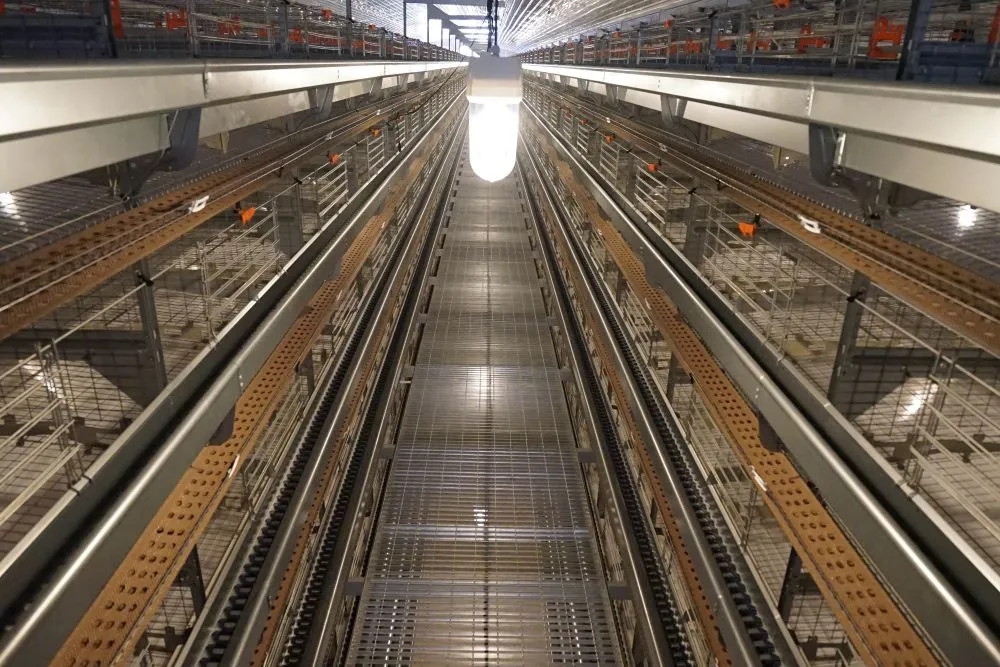
A نظام القفص الطبقي is a structured poultry housing solution for laying hens. It typically combines cage rows, feeding lines, drinkers, egg collection, manure removal, and climate support to improve egg production, reduce labor, and make daily management more efficient.
اقفاص دجاج البياض
Layer cages are important because they organize birds, eggs, feed, and manure into a repeatable daily process. Big Herdsman describes its layer cage system as a high-density poultry housing solution designed for efficient egg production with automated egg collection, manure cleaning, and climate control.
In commercial terms, that organization matters just as much as the cage itself. A strong نظام القفص الطبقي helps farms manage large flocks more consistently and makes the egg-production workflow easier to standardize.
High-quality poultry farm equipment is built around durability, hygiene, stable operation, and system integration. Big Herdsman highlights firm laminated-frame design, stable egg-collection performance, clean water supply, corrosion-resistant manure handling, and highly automated climate control as core product strengths in its layer cage system.
That means “high quality” should be judged by how the system performs in a real house, not only by how it looks in a catalog. For professional انتاج البيض projects, equipment quality shows up in cleaner operation, lower maintenance trouble, and more predictable long-term management.
Layer cages support cleaner egg handling because the system is built around organized egg movement. Big Herdsman’s layer-cage content says the system supports automated egg collection, while its related blog emphasizes cleaner, faster, and more predictable egg management in organized rows.
This is why many farms pair cage housing with التجميع التلقائي للبيض rather than relying on more manual handling. When eggs move out of the bird area quickly, breakage risk and contamination risk both become easier to control.
Big Herdsman’s current cage content describes النوع A cages as simpler, lower-investment, and easier to install, while H-type cages use vertical multi-tier structures and are more closely linked with higher capacity and stronger automation.
In simple terms, A-type systems are often attractive for practical small-to-medium commercial farms, while H-type systems are more common in larger projects that need denser layouts and more automation. The best choice depends on building size, budget, climate, and production goals.
| Cage type | Typical strength | Common fit |
|---|---|---|
| النوع A | Lower investment, simpler installation | Small to medium projects |
| H-type | Higher density, stronger automation | Large commercial farms |
This comparison reflects Big Herdsman’s current layer-cage blog and product guidance.
Automation matters because labor is one of the biggest ongoing pressures in poultry farming. Big Herdsman’s layer-cage articles repeatedly describe automatic feeding, manure removal, and egg collection as core benefits of modern cage systems.
Manure handling is equally important because poor waste control weakens hygiene and makes the house harder to manage. Big Herdsman’s product page specifically highlights a corrosion-resistant manure cleaning system with practical structural design, showing that manure handling is built into the performance value of the cage line.
Climate control affects bird comfort, mortality, and laying performance. Big Herdsman says its climate control system is highly automated and smart, providing a better living environment that can reduce bird mortality and improve laying rate.
That is why many buyers treat التحكم في البيئة as part of the layer-cage decision rather than a separate extra. In a large poultry house, cages, airflow, and temperature control all work together.
Buyers should check farm size, automation level, climate, labor costs, production goals, cage material, and future upgrade needs. Big Herdsman’s current buying guides frame cage selection around these same practical factors.
They should also ask how the cage line will connect to feed, water, egg collection, manure disposal, and airflow. A good quotation answers not only “what does the cage cost?” but also “how will the whole line work in this house?”
Commercial farms prefer integrated solutions because separate equipment decisions often create coordination problems later. Big Herdsman positions its layer systems as complete solutions that integrate multiple components rather than standalone cage frames.
That is also why buyers often evaluate layer cages together with broader معدات مزارع الدواجن planning. In larger projects, the real value comes from how smoothly the full house operates after installation.
A layer cage system can reduce cost over time by supporting lower labor demand, fewer egg losses, more predictable cleaning, and stronger use of building space. Big Herdsman’s product and blog content consistently links layer cages with cost-saving automation and improved management efficiency.
This does not mean every project saves in exactly the same way. But for commercial farms, a better system often reduces hidden cost drivers such as manual handling, inconsistent routines, and weak waste management.

Support matters because even strong equipment still needs correct layout, installation guidance, training, and service. Big Herdsman’s farm-efficiency article says reputable manufacturers should offer installation supervision, training, spare-parts support, remote troubleshooting, and preventive maintenance.
For B2B buyers, this is one of the clearest signs of high-quality poultry farm equipment: the system still works well after it is sold. Long-term support protects uptime, output, and buyer confidence.
It is a structured housing system for laying hens that combines cages with feeding, watering, egg collection, manure removal, and climate support.
Durability, stable operation, hygiene, practical automation, and good system integration are core indicators of quality.
A-type cages are simpler and lower-investment, while H-type cages are denser and more automation-oriented.
Because temperature, airflow, and house conditions directly affect mortality and laying performance.
Commercial farms usually benefit more from integrated solutions that connect cages with egg collection, manure handling, and climate systems.
 Arabic
  English
  Spanish
  French
  Russian
  Portuguese
  Chinese