
الصفحة الرئيسية
الصفحة الرئيسية
Poor airflow can quietly damage poultry production. High ammonia levels, excess humidity, heat stress, and unstable temperature reduce bird comfort and increase production pressure. A modern نظام تهوية الدواجن helps poultry farms maintain healthier, cleaner, and more stable growing conditions.
A poultry ventilation system uses exhaust fans, air inlets, cooling pads, curtains, controllers, heaters, and panel doors to regulate airflow, temperature, humidity, and air quality inside poultry houses. It supports bird welfare, production efficiency, and long-term poultry farm management.
Ventilation affects nearly every part of poultry production. Birds need fresh air, stable temperature, controlled humidity, and low ammonia levels to perform well.
Without proper ventilation:
Modern poultry farms rely on environment control systems to maintain more stable conditions throughout different seasons and climates.
A complete poultry ventilation system includes several connected parts.
| المعدات | Main Function |
|---|---|
| Exhaust fans | Remove stale air and heat |
| Air inlets | Control fresh air entry |
| وسادات التبريد | Reduce incoming air temperature |
| السخانات | Support brooding and cold weather |
| Curtains | Help regulate airflow |
| Controllers | Automate ventilation operation |
| Panel doors | Improve insulation and sealing |
The system should match poultry house size, bird density, local climate, and production goals.
Different poultry farms use different ventilation methods depending on climate and house structure.
Tunnel ventilation uses powerful exhaust fans and air inlets to create fast, controlled airflow through the poultry house.
Advantages include:
Natural ventilation relies more on sidewall openings, curtains, and natural airflow movement.
Advantages include:
For large-scale poultry projects, tunnel ventilation is often preferred because it provides stronger environmental control.
Cooling pads are especially important in hot regions where ventilation alone cannot reduce temperature enough.
Cooling pads work by lowering incoming air temperature before the air enters the poultry house. When combined with proper fan capacity and airflow design, cooling pads help reduce heat stress significantly.
Cooling pad performance depends on:
Poorly designed cooling systems may create uneven airflow or excess moisture inside the house.
Air leakage can reduce ventilation efficiency even when strong fans are installed.
A باب لوحة helps improve insulation and airflow control inside poultry houses. Better sealing helps fresh air move through planned airflow paths instead of entering randomly through gaps.
This improves:
Small construction details often have a large impact on long-term ventilation performance.
Layer farms require stable conditions for long-term egg production. Ventilation affects bird comfort, egg cleanliness, and daily farm management.
حديث نظام القفص الطبقي should work together with ventilation, manure removal, feeding, and egg collection systems.
Good ventilation helps layer farms:
Layer houses often operate for long production cycles, making climate stability especially important.
Broilers grow quickly, so air quality and temperature management directly affect growth performance.
بالنسبة لـ broiler floor rearing systems, ventilation must remove moisture while maintaining proper brooding temperatures.
بالنسبة لـ broiler cage systems, airflow design must account for cage rows, service aisles, and manure handling areas.
Good broiler ventilation supports:
Ventilation performance depends heavily on manure management. Poor manure handling increases ammonia and humidity levels inside the poultry house.
حديث ناقل السماد الخارجي helps move manure outside the poultry house efficiently, improving air quality and reducing odor pressure.
Ventilation and manure systems should always be planned together.
Modern poultry farms increasingly use smart controllers to automate ventilation management.
Smart systems help control:
Automation helps farms improve consistency while reducing manual adjustment pressure.
A poultry ventilation system controls airflow, temperature, humidity, and air quality inside poultry houses using fans, air inlets, cooling pads, and climate control equipment.
Ventilation removes heat, moisture, dust, and harmful gases while supplying fresh air to birds.
Tunnel ventilation uses powerful fans to move air quickly through the poultry house for stronger cooling and airflow control.
In hot climates, cooling pads help reduce incoming air temperature and improve bird comfort.
Poor manure handling increases ammonia and humidity, making ventilation systems work harder.
Yes. Systems can be customized according to poultry type, house size, climate conditions, and automation level.
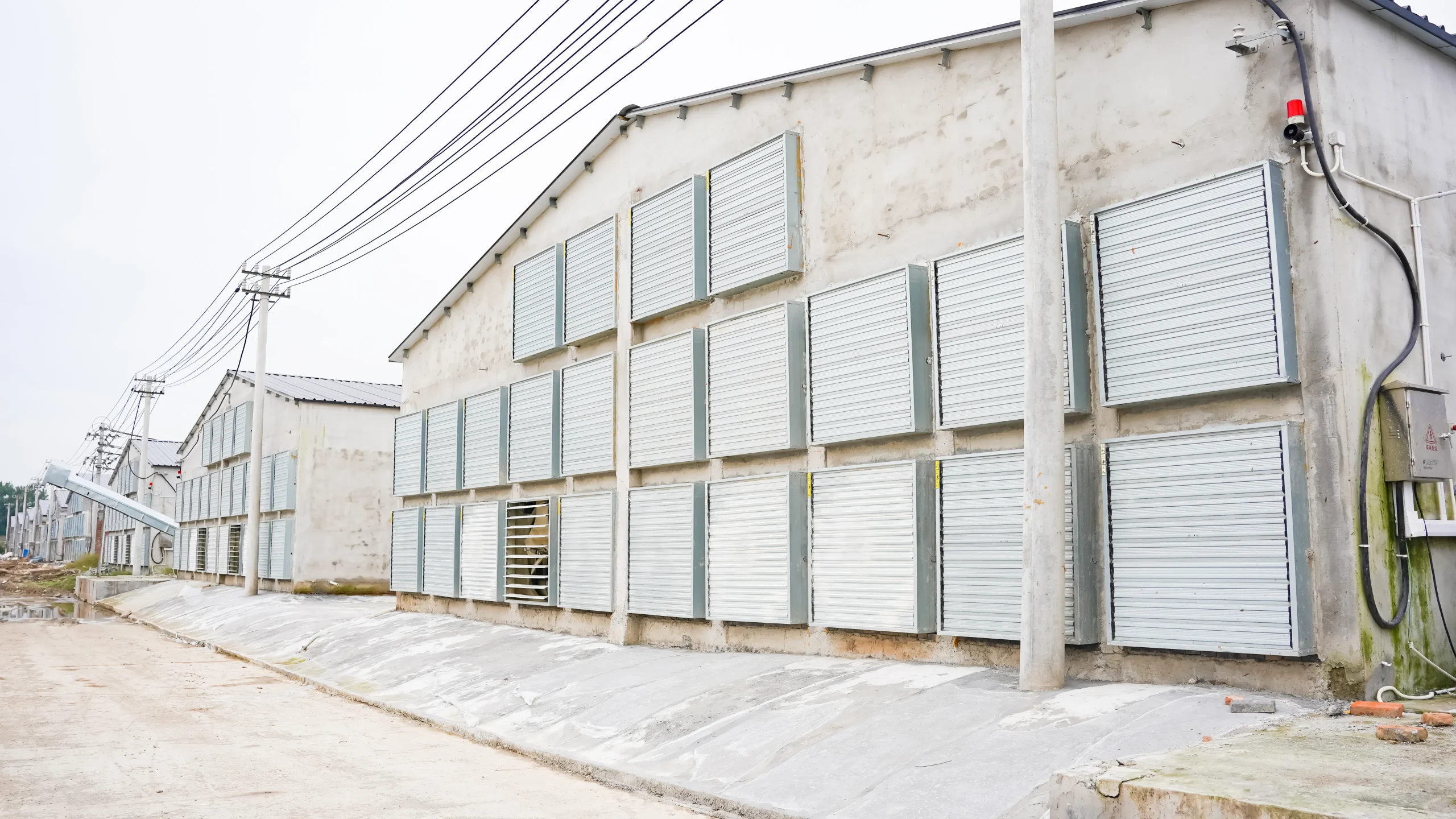
مروحة من نوع الصندوق
 Arabic
  English
  Spanish
  French
  Russian
  Portuguese
  Chinese