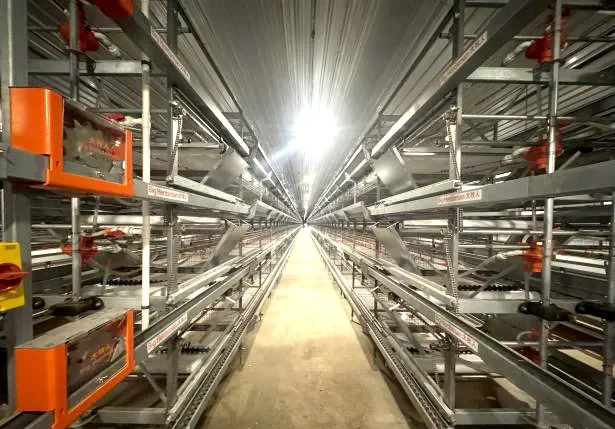
In the contemporary livestock industry, the “shed” has been replaced by a sophisticated biological vessel. The genetic potential of modern poultry—capable of reaching market weight in under six weeks—is a delicate instrument that requires a perfectly stable environment. Any fluctuation in temperature, air quality, or pathogen exposure results in immediate economic loss. Большой пастух approaches poultry house construction not as a civil engineering task, but as the creation of a controlled ecosystem where the steel structure, insulation, and environmental hardware function as a single, airtight machine.
A poultry house is one of the most corrosive environments for steel. The high moisture levels combined with uric acid from manure and the off-gassing of ammonia create a chemical atmosphere that accelerates oxidation.
Traditional painted or pre-galvanized steel often fails within five to seven years because the raw edges exposed during cutting and welding become points of entry for rust.
The Big Herdsman Standard: Every structural component—from the main H-beams to the purlins and cage supports—undergoes a post-fabrication hot-dip galvanization process. By dipping the fully welded component into a 450°C zinc bath, we ensure that every joint and crevice is encased in a protective zinc-iron alloy.
Life-Cycle ROI: This treatment extends the structural life of the facility to over 20 years, even in high-humidity tropical climates, significantly reducing the long-term cost of ownership.
A structure is only as strong as its weakest connection. Big Herdsman utilizes specialized Dacromet-coated or stainless steel bolts and self-tapping screws. These materials are specifically chosen to resist the aggressive cleaning chemicals and acidic vapors prevalent in intensive farming operations.
In high-density production, the building envelope must manage massive heat loads from the sun (external) and the birds (internal).
Big Herdsman utilizes high-density Polyurethane (PU) or Rockwool sandwich panels for wall and roof construction.
R-Value Optimization: The insulation thickness is calculated based on the local climate. In arid regions, the panel blocks solar radiation, keeping the interior cool; in cold climates, it prevents heat loss, drastically lowering the energy consumption of the heating system during the brooding stage.
Thermal Bridge Prevention: Our panels utilize an interlocking tongue-and-groove system that eliminates “thermal bridges”—gaps where heat or cold can bypass the insulation. This ensures that the house temperature remains uniform from wall to wall.
A modern house relies on negative pressure ventilation. If the building leaks air through gaps in the doors or wall joints, the fans cannot maintain the static pressure required to pull air through the cooling pads or inlets.
Engineering the Seal: Big Herdsman houses are engineered for a “Zero-Leak” standard. This allows the environmental controller to maintain a precise vacuum, ensuring that 100% of the air entering the house is filtered and cooled before it reaches the birds.
Biosecurity is often discussed in terms of vaccines and chemicals, but the most effective defense is physical exclusion.
Wild birds, rodents, and insects are the primary vectors for Avian Influenza and Salmonella.
Structural Barriers: Every air inlet, exhaust fan, and door frame is fitted with high-precision mesh screens. These are integrated into the steel frame during the engineering phase, not added as an afterthought. This ensures a seamless fit that prevents even the smallest rodent from entering the facility.
Smooth Surface Sanitation: Internal structural members are designed to be “wash-friendly.” We minimize ledges and crevices where dust and pathogens can accumulate. After a flock is moved, the entire steel and panel interior can be high-pressure washed and disinfected without fear of water damage to the insulation or structural rust.
By automating the feed silos, manure removal conveyors, and egg collection systems, Big Herdsman reduces the necessity for human staff to enter the core production zone. The “Turnkey” layout places all service points—such as the egg grading room and the manure loading bay—outside the primary biosecurity envelope, creating a “Clean/Dirty” boundary that is easy to manage.
The most significant risk in farm construction is “system friction”—when the cages do not fit the building or the fans are incompatible with the controller.
Synchronized Engineering: When Big Herdsman delivers a turnkey project, the building is designed around the equipment. The foundation is pre-calculated for the weight of the cages, and the wall panels come pre-cut for the exact dimensions of the air inlets and fans.
Rapid Deployment: This level of pre-engineering reduces construction time by up to 30%, allowing producers to start their first cycle months earlier than a traditional fragmented build.
As the poultry industry moves toward higher density and stricter environmental regulations, the building itself must become smarter. A Big Herdsman facility is not just an asset; it is an insurance policy. By integrating superior metallurgy, advanced thermal engineering, and biosecurity exclusion, we build the infrastructure required to feed a global population safely and sustainably.
Большой пастух

 Russian
  English
  Spanish
  French
  Portuguese
  Arabic
  Chinese