
El hombre que practica yoga
El hombre que practica yoga
Manual egg collection becomes harder as poultry farms grow larger. Workers spend more time walking cage rows, eggs face higher breakage risk, and production efficiency becomes difficult to maintain. An sistema automático de recogida de huevos helps layer farms reduce labor pressure, improve egg handling, and create a cleaner, more organized production workflow.
An automatic egg collection system uses egg belts, elevators, conveyors, transfer units, and centralized collection lines to move eggs safely from cages to collection areas. It supports higher daily egg output, reduces manual handling, improves hygiene, and helps poultry farms build more efficient egg production systems.
[Image Placeholder]
Egg collection is one of the most repetitive jobs in a poultry farm. As flock size increases, manual collection becomes slower and less practical. Workers must move through long cage rows multiple times every day, which increases labor cost and handling pressure.
Un moderno sistema de recolección de huevos helps poultry farms automate the movement of eggs from cage rows to collection points. This improves consistency and supports larger-scale poultry production.
Automatic collection systems help farms:
| Farm Challenge | System Benefit |
|---|---|
| High labor demand | Reduces manual egg handling |
| Egg breakage | Improves transport consistency |
| Slow collection | Speeds up daily workflow |
| Dirty eggs | Reduces repeated contact |
| Expansion pressure | Supports larger production capacity |
For commercial farms, egg collection should not be treated as a single machine purchase. It should match the full poultry house design.
A complete automatic egg collection system may include several connected parts depending on the farm layout and automation level.
Common equipment includes:
For farms with longer poultry houses, an transportador de huevos helps transport eggs smoothly from multiple cage rows to centralized packing or grading areas.
The system should be selected according to:
The performance of an automatic egg collection system depends heavily on the layer cage layout. Cage slope, egg rolling angle, aisle width, belt position, and collection routes all affect how smoothly eggs move through the house.
Un moderno sistema de jaulas por capas should be planned together with egg collection, manure removal, ventilation, drinking, and feeding systems.
Good cage integration helps:
If the cage design and egg collection layout are not matched correctly, the farm may experience uneven egg movement or higher breakage rates later.
Manual egg collection may work for smaller farms, but large commercial farms usually need more consistent and scalable solutions.
| Factor | Manual Collection | Automatic Collection |
|---|---|---|
| Labor requirement | Alta | Baja |
| Collection speed | Slower | Faster |
| Egg handling consistency | Depends on workers | More stable |
| Breakage control | Menos previsible | Better controlled |
| Escalabilidad | Limited | Suitable for large farms |
| Daily workload | Heavy | More manageable |
For B2B poultry projects, the long-term operational value of automation is often more important than the initial equipment price.
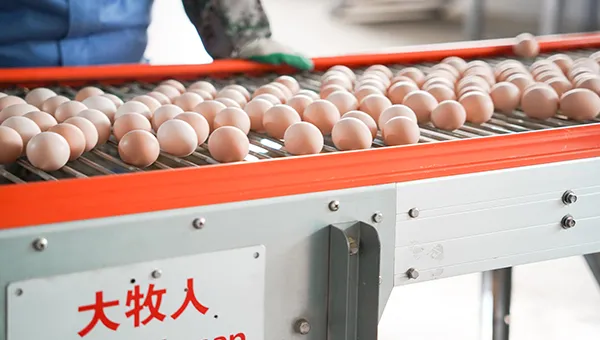
As farms become larger, egg handling inside the poultry house becomes more complex. Egg conveyors help move eggs safely over longer distances while reducing repeated manual transfer.
Big Herdsman’s egg conveyor systems are designed for smooth, low-breakage egg transportation inside commercial poultry farms. The system supports stable egg movement between cage rows and centralized collection areas.
Egg conveyors help farms:
For farms planning future expansion, conveyor routing should be included in the early house design stage.
Egg collection performance is affected by the poultry house environment. Poor ventilation, high humidity, and unstable temperature can increase dust, moisture, and egg contamination risk.
A stable environment control system helps maintain cleaner poultry house conditions for better egg handling.
Important climate control equipment includes:
A puerta de panel helps improve insulation and airflow management, supporting better temperature stability and cleaner conditions around egg collection areas.
Manure management directly affects egg hygiene and poultry house air quality. If manure remains too long inside the house, ammonia, dust, and humidity levels rise.
An efficient manure handling system helps support:
Gran pastor Transportador de estiércol exterior helps poultry farms transport manure outside the poultry house more efficiently, supporting cleaner egg production environments.
Egg collection and manure removal should always be designed together.
Breeder farms require even more careful egg handling because fertilized eggs are more sensitive and valuable than ordinary table eggs.
A Jaula para gallinas ponedoras supports controlled egg collection, reasonable bird management, adjustable drinking systems, and automatic environmental monitoring.
For breeder operations, automatic egg collection helps:
The higher the egg value, the more important gentle egg transport becomes.
Modern poultry farms increasingly use automation to improve consistency and reduce repetitive labor.
Smart automation can help control:
For large farms, smart systems help managers monitor daily production more efficiently while reducing operational mistakes.
Automation does not only reduce labor. It also improves workflow predictability and production organization.
Before choosing equipment, poultry farms should evaluate their production goals and house conditions carefully.
Key planning questions include:
| Planning Point | Why It Matters |
|---|---|
| Daily egg output | Determines collection capacity |
| House dimensions | Affects conveyor routing |
| Cage tier quantity | Affects elevator design |
| Labor availability | Affects automation level |
| Climate conditions | Affects equipment protection |
| Future expansion | Affects system scalability |
| Packing workflow | Affects conveyor direction |
A professional supplier should recommend systems based on the actual poultry house design rather than offering a standard configuration for every farm.
Automatic egg collection works best when integrated with the entire poultry production system.
A system-level supplier helps coordinate:
Big Herdsman focuses on integrated poultry farming systems, combining equipment manufacturing, system design, installation guidance, and long-term technical support for global B2B poultry projects.
Farm owners, poultry investors, engineering contractors, and equipment distributors can contact Big Herdsman’s poultry equipment team to discuss customized automatic egg collection solutions.
An automatic egg collection system uses belts, conveyors, elevators, and transfer equipment to move eggs automatically from cages or nests to centralized collection areas.
The system reduces the need for workers to collect eggs manually across long cage rows, improving efficiency and reducing repetitive labor.
Yes. Controlled egg movement and reduced manual handling help lower breakage risk and improve egg transport consistency.
Yes. Breeder farms especially benefit from gentle egg handling because fertilized eggs require lower vibration and better protection.
Yes. Systems can be customized according to poultry house size, cage layout, egg output, automation level, and future expansion plans.
Because air quality, humidity, and hygiene directly affect egg cleanliness and system performance inside the poultry house.
Transportador de huevos Big Herdsman
 English English
  Spanish
 French
 Russian
 Portuguese
 Arabic
 Chinese
