Les élevages de poules pondeuses commerciaux ont besoin de plus que de simples cages pour rester compétitifs. La pression sur la main-d'œuvre, la casse des œufs, une mauvaise aération et une gestion difficile du fumier peuvent réduire l'efficacité de l'exploitation agricole au fil du temps. système de cages à étages aide les élevages de volailles à améliorer leur flux de production d'œufs, l'utilisation de l'espace, l'hygiène et l'automatisation.
Un système de cages pour pondeuses combine cages à volailles, systèmes d'alimentation, lignes d'abreuvement, ramassage des œufs, évacuation du fumier, ventilation et contrôle climatique en une seule structure de production intégrée. Elle favorise une gestion plus propre, une intensité de main-d'œuvre moindre et une production commerciale d'œufs plus organisée.
Qu'est-ce qu'un système de cages à étages ?
Un système de cages pour pondeuses est une solution d'élevage avicole structurée conçue pour les poules pondeuses commerciales. Au lieu d'être en liberté sur le sol, les poules sont organisées en rangées de cages reliées à des systèmes d'alimentation, d'abreuvement, de ramassage des œufs et d'évacuation des déjections.
Moderne systèmes de cages de ponte soutien:
- Alimentation automatique
- Systèmes d'abreuvement à tétine
- Collecte d'œufs
- Enlèvement du fumier
- Climatisation
- Gestion de l'éclairage
Pour les grandes exploitations avicoles commerciales, les systèmes intégrés améliorent la régularité des opérations et simplifient la gestion quotidienne.
Pourquoi les élevages commerciaux utilisent-ils des systèmes de cages pour poules pondeuses ?
Avec l'expansion des élevages de volailles, la gestion manuelle devient plus difficile. Les systèmes de cages pour pondeuses permettent d'organiser la production plus efficacement.
Les principaux avantages sont les suivants :
| Besoins agricoles |
Avantages du système de cage |
| Capacité d'élevage d'oiseaux plus élevée |
Meilleure utilisation de l'espace |
| Réduction de la main-d'œuvre |
Prend en charge l'automatisation |
| œufs nettoyeurs |
Meilleure manipulation des œufs |
| Gestion simplifiée |
Agencement structuré en cage |
| Hygiène améliorée |
Élimination intégrée du fumier |
| Production stable |
Meilleur contrôle des conditions ambiantes |
Pour les élevages de poules pondeuses commerciaux, l'objectif n'est pas seulement d'augmenter le nombre de cages. L'objectif est un système de production plus organisé.
Principaux composants d'un système de cages en étages
Un système complet de cage à pondeuses comprend plusieurs éléments interconnectés.
L'équipement commun comprend :
- cages à pondeuses
- Systèmes d'alimentation
- Systèmes d'abreuvement
- Systèmes de collecte des œufs
- Convoyeurs à œufs
- Systèmes d'élimination du fumier
- Équipement de ventilation
- Coussins de refroidissement
- contrôleurs environnementaux
- Systèmes d'éclairage
Chaque système influe sur les autres, la planification doit donc être effectuée conjointement plutôt que séparément.
Collecte automatique des œufs dans les systèmes de cages pour pondeuses
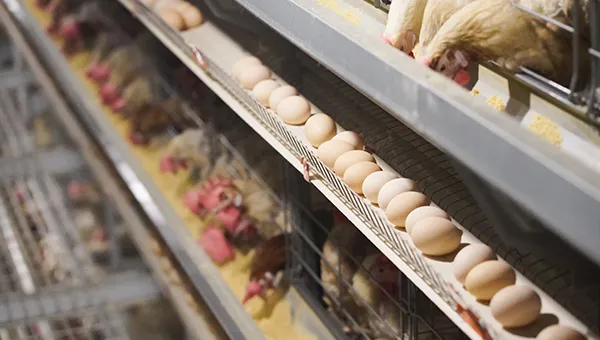
La collecte des œufs est l'une des fonctions les plus importantes dans un système d'élevage de poules pondeuses en cage.
Un système de collecte d'œufs permet de déplacer les œufs en douceur des rangées de cages vers les points de collecte, réduisant ainsi la manutention manuelle et les risques de casse.
Pour les poulaillers de plus grande taille, un convoyeur d'œufs assure le transport centralisé des œufs entre les poulaillers et les zones de conditionnement.
La collecte automatique des œufs aide les exploitations agricoles :
- Réduire la charge de travail
- Améliorer la vitesse de collecte
- Réduire les dommages aux œufs
- Améliorer l'organisation du flux de travail
- Soutenir une plus grande capacité de production
Systèmes d'alimentation et d'abreuvement pour les élevages de poules pondeuses
Un accès régulier à l'alimentation et à l'eau est essentiel pour une production d'œufs constante.
Un système moderne de cages pour poules pondeuses comprend généralement des systèmes de distribution automatique d'aliments et d'abreuvement à tétines. Ces systèmes contribuent à maintenir des conditions d'élevage plus propres tout en réduisant le gaspillage d'aliments et les fuites d'eau.
Les bons systèmes d'alimentation et d'abreuvement favorisent :
- Une meilleure uniformité du troupeau
- Rythme de production stable
- Réduction de la main-d'œuvre
- Conditions plus propres pour les poulaillers
La hauteur de la ligne d'abreuvement et la distribution de l'aliment doivent être adaptées à l'âge des oiseaux et à la conception de la cage.
Élimination du fumier et hygiène des poulaillers
Des conditions d'élevage propres sont essentielles pour une production d'œufs à long terme.
Les systèmes modernes de gestion du fumier permettent d'éliminer les déchets plus régulièrement, améliorant ainsi la qualité de l'air et réduisant l'accumulation d'ammoniac.
Un convoyeur à fumier extérieur permet de transporter le fumier à l'extérieur du poulailler pour le stockage ou le traitement.
Une meilleure gestion du fumier favorise :
- Air plus pur
- Pression olfactive plus faible
- Entretien de la maison facilité
- de meilleures conditions de travail
- Amélioration de l'hygiène des œufs
Ventilation et régulation climatique dans les systèmes de cages pour poules pondeuses
Les poules pondeuses donnent de meilleurs résultats dans un environnement stable. Une mauvaise ventilation et le stress thermique peuvent réduire la production d'œufs et compliquer l'élevage.
Un moderne système de contrôle environnemental contribue à réguler :
- Température
- Flux d'air
- Humidité
- Eclairage
- Climatisation et chauffage
A porte à panneaux Il contribue également à la gestion du flux d'air et à l'amélioration des performances d'isolation à l'intérieur des poulaillers.
Systèmes de cages multicouches de type A et de type H
Différentes structures de cages conviennent à différents élevages avicoles.
Systèmes de cages de type A
- Coût d'investissement inférieur
- structure plus simple
- Adapté aux exploitations agricoles de taille moyenne
- Installation plus facile
Systèmes de cages de type H
- Potentiel d'automatisation plus élevé
- Meilleure utilisation de l'espace
- Convient aux grandes exploitations agricoles commerciales
- Gestion centralisée simplifiée
Le meilleur choix dépend de la taille de l'exploitation, du budget, des conditions de travail et des projets d'expansion futurs.
Automatisation intelligente dans les élevages de poules pondeuses
Les systèmes modernes de cages pondeuses utilisent de plus en plus l'automatisation pour améliorer la régularité de leur fonctionnement.
L'automatisation peut prendre en charge :
- Horaires des repas
- Moment de la collecte des œufs
- Climatisation
- Programmes d'éclairage
- Systèmes d'alarme
- Suivi de la production
Pour les grandes exploitations avicoles, l'automatisation réduit les tâches répétitives et améliore l'efficacité de la gestion.
Comment choisir un système de cages pour poules pondeuses
Avant de choisir leur équipement, les exploitations agricoles doivent évaluer :
| Point de planification |
Pourquoi est-ce important ? |
| quantité d'oiseaux |
Détermine la capacité de la cage |
| Dimensions de la maison |
Affecte la conception de la mise en page |
| Climat local |
Détermine les besoins en refroidissement et en ventilation |
| disponibilité de la main-d'œuvre |
Affecte le niveau d'automatisation |
| Plans d'expansion |
Affecte l'évolutivité |
| Flux de travail de collecte des œufs |
Affecte le routage du convoyeur |
Un fournisseur professionnel devrait concevoir le système en fonction des conditions réelles de l'exploitation plutôt que de proposer une configuration standard pour chaque projet.
Questions fréquemment posées
Qu'est-ce qu'un système de cages en étages ?
Un système de cages pour pondeuses est un système d'élevage de volailles structuré conçu pour les poules pondeuses commerciales avec alimentation, abreuvement, collecte des œufs, évacuation du fumier et contrôle climatique intégrés.
Quels sont les avantages d'un système de cages pour poules pondeuses ?
Les avantages comprennent une meilleure utilisation de l'espace, une demande de main-d'œuvre réduite, une meilleure manipulation des œufs, une gestion plus propre et un soutien accru à l'automatisation.
Quelle est la différence entre les cages à étages de type A et celles de type H ?
Les cages de type A sont plus simples et moins coûteuses, tandis que les cages de type H permettent une automatisation plus poussée et conviennent aux projets d'élevage de volailles commerciaux de plus grande envergure.
Pourquoi la collecte automatique des œufs est-elle importante ?
La collecte automatique des œufs réduit la manutention manuelle, améliore la vitesse de collecte et diminue le risque de casse des œufs.
Les systèmes de cages à poules pondeuses peuvent-ils être personnalisés ?
Oui. Les systèmes peuvent être personnalisés en fonction de la taille du bâtiment, de la capacité du troupeau, des conditions climatiques et des objectifs d'automatisation.
Pourquoi faut-il planifier la ventilation et l'évacuation du fumier en même temps que la construction des cages ?
Car la qualité de l'air, l'hygiène et le bien-être des volailles influent directement sur la production d'œufs et l'efficacité de l'élevage.
Cage de couche Big Herdsman
 English
  Spanish
 French
 Russian
 Portuguese
 Arabic
 Chinese
 German
 Italian
 Japanese
 Korean
 Turkish
 Vietnamese
 Thai
Thai
 Dutch
Dutch
 Polish
 Indonesian
 Hindi
Hindi
 Bengali
 Urdu
Urdu